
One-Step Electrochemical Synthesis of Multiyolk–Shell Nanocoils for Exceptional Photocatalytic Performance
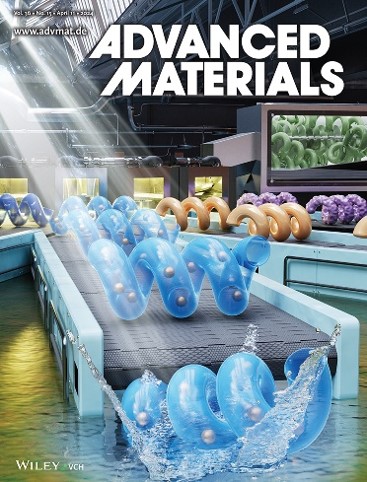
본 연구에서는 원통형의 다공성 템플릿 내에서 전기도금법으로 이종 코발트-철 합금 나노코일을 합성한 후, 전기화학적으로 디자인된 용액 내에서 코발트와 철이 녹아 나오는 속도 차이를 이용하여 원-스텝 과정(one-step process)으로 다중요크-쉘 나노코일을 합성하였다. 주형으로 사용된 코발트-철 나노코일은 전기화학에 기반한 갈바닉 교환 반응(Galvanic exchange reaction) 및 커켄달 효과(Kirkendall effect)에 의해 다중요크-쉘 나노코일 구조로 성공적으로 전환되었다.
수용액 환경에서 물질 반응의 자발성은 이온 종의 종류 및 농도, 용액의 pH, 온도 등에 따라 조절 가능하다. 특정 조건의 용액 내에서 자발적으로 일어나는 갈바닉 교환 반응은 물질 간의 산화·환원 반응을 일으켜 본래의 물질 형상을 따라 새로운 물질로의 교환을 가능하게 한다. 이때, 반응 물질과 용액 계면에서의 반응속도를 조절하면 서로 다른 확산 속도로 인해 물질의 내부에는 점점 공극이 생기게 되고 최종적으로 속이 빈 형태의 물질 합성을 가능하게 한다.
반응 물질의 최종 이온 종류와 반응경로를 고려하여 수용액을 디자인하여 서로 다른 8가지의 나노코일 기반 구조체를 합성하였다. 코발트-철 나노코일 주형으로부터 합성된 나노구조체는 내부에 금 혹은 백금 나노입자가 존재하는 인산화 철 기반의 다중요크-쉘 나노코일, 인산화 철 중공 나노코일, 표면이 거친 백금 나노코일과 망간인산염 중공 나노코일, 표면이 매끄러운 금 나노코일과 크롬인산염 중공 나노코일, 그리고 알루미늄이 도핑된 망간인산염 중공 나노코일이 있다.
그 중 금-인산화 철 다중요크-쉘 나노코일(Au-FePO4 mYSNC)은 넓은 표면적과 빛의 흡수를 극대화하는 구조, 금 입자의 국소 표면 플라스몬 공명(LSPR) 효과, 전하-정공 재결합을 방지하며 분해 반응을 유도하는 금속-반도체 이종접합의 밴드 구조로 기존의 소재에 비해 높은 광분해 효율을 가지는 것을 확인하였다.
In this study, we synthesized Co-Fe alloy nanocoils via electrodeposition within a cylindrical porous template. Subsequently, multi-yolk-shell nanocoils were synthesized using a one-step process that leverages the differential dissolution rates of cobalt and iron in an electrochemically designed solution. The Co-Fe nanocoils used as templates were successfully converted into multi-yolk-shell nanocoil structures through a galvanic exchange reaction and the Kirkendall effect.
The spontaneity of material reactions in aqueous environments can be controlled by factors such as the type and concentration of ionic species, pH of the solution, and temperature. In a specifically designed solution, spontaneous galvanic exchange reactions enable the oxidation-reduction reactions between materials, allowing the exchange of the original material into a new one while maintaining the original shape. By controlling the reaction rate at the interface between the reactant material and the solution, voids form inside the material due to different diffusion rates, ultimately enabling the synthesis of hollow structures.
By considering the final ionic species and reaction pathways of the reactants, eight different nanocoil-based structures were synthesized. The nanostructures synthesized from the Co-Fe nanocoil templates include multi-yolk-shell nanocoils with gold or platinum nanoparticles inside iron phosphate, hollow iron phosphate nanocoils, rough-surfaced platinum nanocoils, hollow manganese phosphate nanocoils, smooth-surfaced gold nanocoils, hollow chromium phosphate nanocoils, and aluminum-doped hollow manganese phosphate nanocoils.
Among these, the gold-iron phosphate multi-yolk-shell nanocoil (Au-FePO4 mYSNC) exhibited a high photocatalytic efficiency compared to existing materials due to its structure that maximizes surface area and light absorption, the localized surface plasmon resonance (LSPR) effect of gold particles, and the band structure of the metal-semiconductor heterojunction that prevents charge recombination and induces decomposition reactions.